

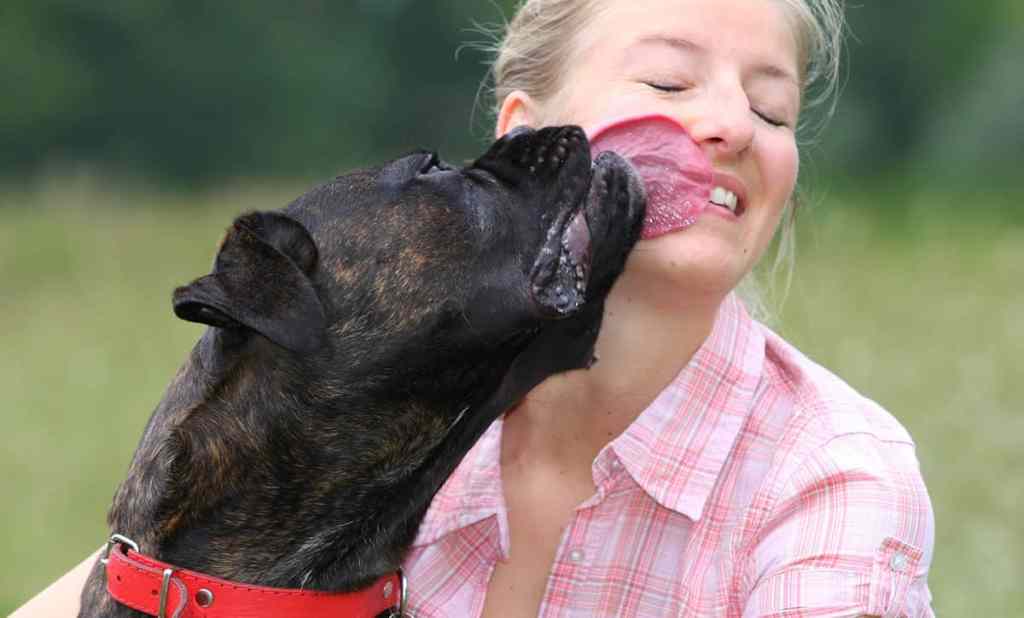
Most of us assume and verify that our dog’s love and affection for us are expressed through kisses delivered to us when we return home. Those “kisses”, or rather licks (slobbery licks to the face; focused, exhaustive licking of the hand; solemn tongue-polishing of a limb. Even Charles Darwin expressed the idea of him receiving lick-kisses from his dog. He was certain that dogs have a striking way of exhibiting their affection by licking the hands or faces of their masters. Was Darwin right? Are those dog kisses really gestures of affection to the Dog?

Researchers of wild canids – wolves, coyotes, foxes, and other wild dogs – report that puppies lick the face and muzzle of their mother when she returns from a hunt to her den – in order to get her to regurgitate for them. Licking around the mouth seems to be the cue that stimulates her to vomit up some nicely partially digested meat.
Furthermore, our mouths taste great for dogs. Like wolves and humans, dogs have taste receptors for salty, sweet, bitter, sour, and even umami, the earthy, mushroomy-seaweedy flavor captured in the flavor-heightening monosodium glutamate. Their reception of sweetness is processed slightly differently than ours, in that salt enhances the experience of sweet tastes. The sweet receptors are particularly abundant in dogs, although some sweeteners like sucrose and fructose activate the receptors more than others, such as glucose. This could be adaptive in an omnivore-like dog, for whom it pays to distinguish between ripe and non-ripe plants and fruits. Interestingly, even pure salt doesn’t kick start the so-called salt receptors on the tongue and the roof of the mouth in dogs the way it does in humans.

The good news is, as a result of this functional use of mouth licking, the behavior has become a ritualized greeting. In other words, it no longer serves only the function of asking for food, now it is used to say hello. Dogs and wolves muzzle-lick simply to welcome another dog back home, and get an olfactory report of where the home-comer has been or what he has done. Mothers not only clean their pups by licking, they often give a few darting licks when reuniting after even a brief time apart. A younger or timid dog may lick the muzzle, or muzzle vicinity, of a bigger, threatening dog to appease him.

Familiar dogs may exchange licks when meeting at the ends of their respective leashes on the street. It may serve as a way to confirm, through smell that this dog storming toward them is who they think he is.
Since these “greeting licks” are often accompanied by wagging tails, mouths opened playfully, and general excitement, it is not a strech to say that the licks are a way to express happiness that you have returned. Let’s love them more.
 G.I. Takara Kennel Blog